
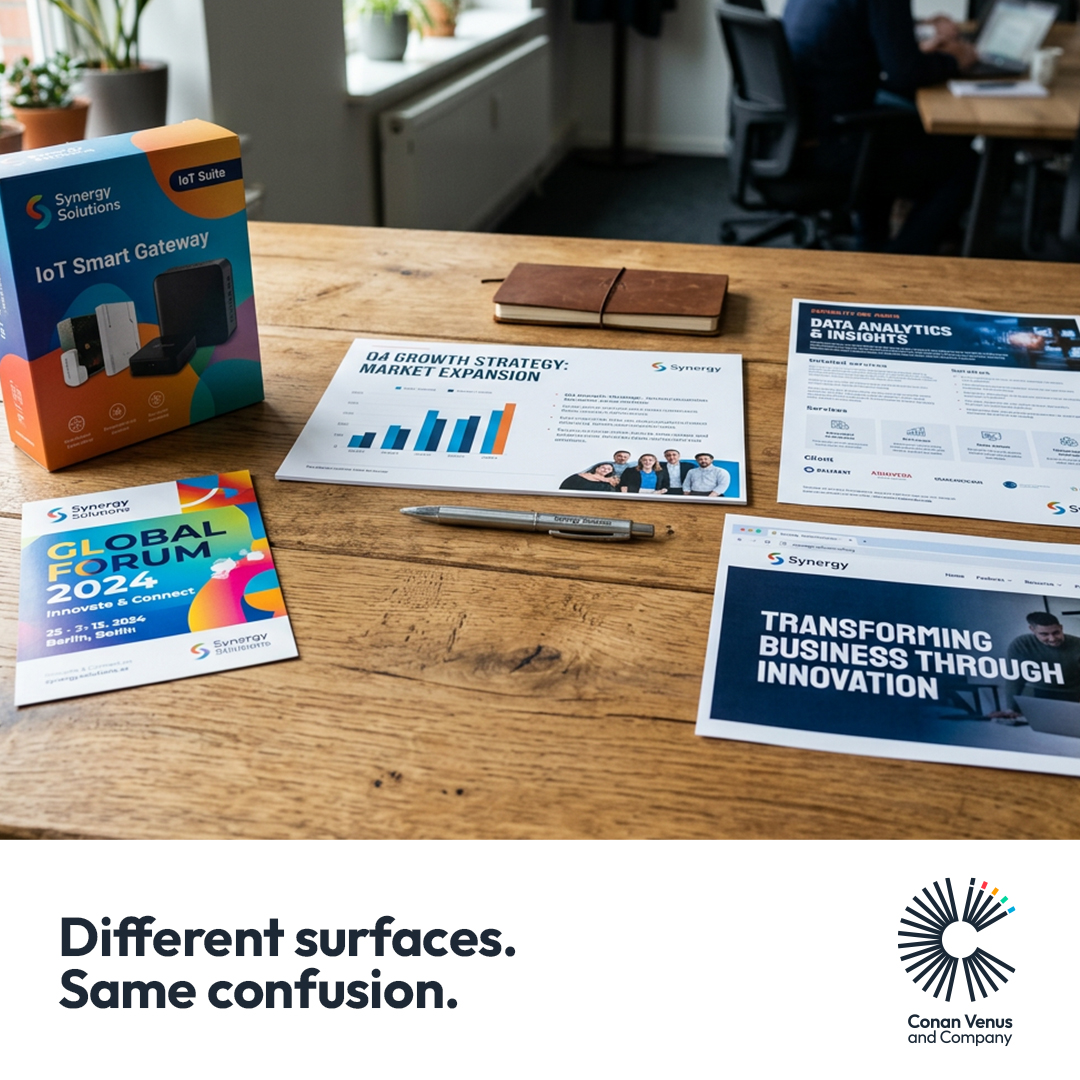
Brand confusion rarely feels dramatic.
There’s no obvious collapse. No formal decision to abandon positioning. Work continues. Campaigns launch. Sales conversations evolve. The brand keeps moving.
Over time, however, something becomes harder to describe. Different parts of the organization begin to emphasize different strengths. Nothing appears broken, yet the overall message becomes less coherent.
Across CPG and B2B environments, this pattern shows up in different ways. The context changes. The structural mechanics often don’t.
Brand confusion tends to form gradually, especially when new messages are added without older ones being reconsidered.
In CPG environments
In CPG, messaging shifts frequently because retail environments demand movement.
Seasonal campaigns rotate. Promotional language adapts. Sustainability claims gain prominence. Performance benefits take turns leading, depending on channel and timing.
Each shift can be justified. Many of them perform.
Over time, however, the emphasis moves. Packaging might highlight one attribute. Paid campaigns may lead to another. Retail materials may introduce a third angle. The brand still appears active and visible, yet the central idea becomes less distinct.
Internally, this often feels like agility. Externally, it can make the product harder to summarize.
Customers may understand what the product does, but they may struggle to explain what defines it.
In B2B organizations
In B2B settings, the surface pattern looks different.
Capabilities expand. New services are introduced. Case studies accumulate. Sales teams adapt language to address varied buyers.
Each adjustment can help close a deal.
As offerings broaden, positioning stretches alongside them. Value propositions multiply. Messaging becomes tailored, then fragmented. Different decks highlight different strengths. Website copy evolves in sections rather than as a whole.
The organization continues to sound competent. What becomes harder is articulating a single, repeatable idea that anchors everything else.
Buyers may leave conversations impressed yet unsure how to describe the company clearly.
What sits underneath both
The industries operate differently, yet the underlying dynamic is similar.
Growth introduces new priorities. Those priorities introduce new messages. Older messages tend to remain active.
Without periodic review, everything stays technically accurate. What becomes less clear is what should lead.
Hierarchy drifts quietly.
Brand confusion reflects accumulation without coordination.
Why internal teams struggle to see it
Brand confusion often emerges from reasonable decisions made independently.
Marketing adjusts language to improve performance.
Sales adapts positioning to address objections.
Product highlights emerging strengths.
Each shift may improve results in isolation.
The difficulty lies in seeing how those shifts interact across the organization. When messaging spans multiple teams, materials, and timelines, fragmentation can remain subtle.
Leadership may sense that positioning feels diluted before they can describe the cause precisely. Conversations require more context. Explanations grow longer. Alignment discussions become more frequent.
At that stage, what’s missing is not more creativity. It is structured visibility.
How CVAC’s Marketing Audit addresses brand confusion
Brand confusion does not resolve through incremental edits alone.
When messaging spans campaigns, sales materials, and product claims, the first step is a structured review of how the brand currently operates.
At CVAC, we offer a Marketing Audit specifically designed to identify and resolve brand confusion.
The audit examines how your brand appears across:
- Website and digital channels
- Campaign messaging
- Sales materials
- Product claims
- Internal positioning documents
Rather than evaluating assets in isolation, we assess how they operate together.
This process makes visible:
- Where focus has widened beyond the intended audience
- Where the central promise shifts across channels
- Where proof points compete rather than reinforce
- Where the message hierarchy has drifted
Brand confusion often lives in these gaps.
By clarifying how messaging behaves as a system, leadership can make deliberate decisions about what should lead, what should support, and what should be retired.
For some organizations, the outcome is targeted refinement. For others, the audit reveals the need for deeper structural alignment through a Brand and Message Sprint.
In every case, the Marketing Audit provides the foundation for resolving confusion rather than layering additional messaging on top.
Moving forward
At CVAC, we work with both CPG and B2B teams facing this exact pattern.
Brand confusion often reflects growth without periodic realignment.
CVAC’s Marketing Audit is designed to bring that alignment back into view.
If messaging feels heavier, harder to repeat, or less consistent across teams than it once did, reviewing how the brand is functioning as a system can provide clarity about the next step.
We offer Marketing Audits to help organizations identify where brand confusion has developed and define the structural adjustments required to restore coherence.
If you would like to explore whether that review makes sense in your context, we are open to a conversation.