
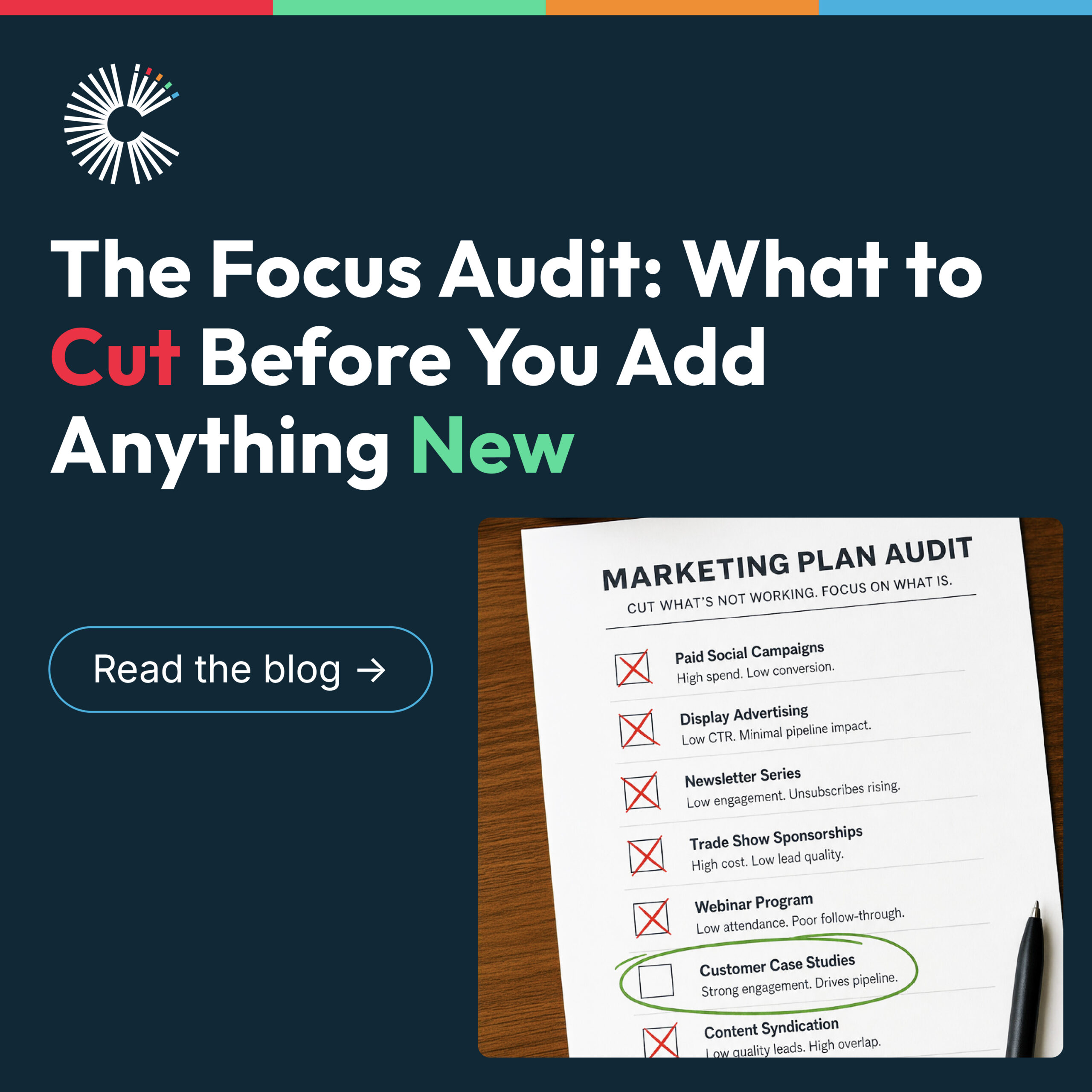
Every marketing plan has a growth problem, and it isn’t the one you think.
Plans don’t struggle to grow. They grow constantly. A new channel gets added because a competitor is on it. A webinar series starts because someone saw one work at a conference. A monthly newsletter launches, a trade show stays on the calendar, and a retainer renews automatically. Year after year, the plan gets bigger.
What almost never happens is the opposite. Very few teams sit down and decide on purpose what to cut from their marketing plan before adding the next thing.
That’s how a focused strategy slowly turns into a crowded one. Not through one bad decision, but through dozens of reasonable ones that were never revisited. The budget gets spread thinner, the team gets stretched wider, and the work that actually drives results has to compete for attention with work that stopped mattering a long time ago.
Adding without cutting doesn’t make a plan more ambitious. It makes it heavier.
The Focus Audit is how we fix that. It’s five questions, applied to every tactic, channel, and program currently running. You can do it in an afternoon, and as Q4 wraps up and 2027 planning begins, there’s no better time.
How to Run the Focus Audit
Start by listing everything your marketing is doing right now. Not just the big campaigns. Everything:
- Every channel you post on or advertise in
- Every recurring piece of content (newsletters, blog series, monthly reports)
- Every event, sponsorship, and trade show on the calendar
- Every tool, platform, and subscription
- Every agency or freelancer retainer
Then run each item through the five questions below. Be honest. The audit only works if “we’ve always done it” isn’t treated as a reason.
Q1: Has This Tactic Produced a Measurable Result in the Last 90 Days?
No result in 90 days is a signal, not a coincidence.
Ninety days is long enough for almost any tactic to show something: a lead, a conversation, a meaningful lift in traffic, a sales team saying “that piece helped close the deal.” It doesn’t have to be a closed sale. It does have to be real.
If a tactic has run for a full quarter and you can’t point to a single result, that’s not bad luck. It’s information. Either the tactic isn’t working, or you aren’t measuring it, and both problems need fixing before you put more money behind it.
This question tends to surface the quiet line items: the sponsorship nobody tracks, the social channel posting into silence, the content series that gets produced every month and read by almost no one.
Q2: Could You Explain Its Job in One Sentence, Without Hedging?
‘It’s good for visibility’ is not a job. It’s an excuse.
Every tactic in your plan should have a clear job. “Our LinkedIn Document posts generate qualified conversations with plant operations leaders.” “Our trade show presence produces 30 distributor meetings a year.” Those are jobs.
“It keeps us top of mind.” “It’s good for brand awareness.” “It’s part of the mix.” Those are hedges. They’re what we say when we can’t name what something actually does.
Visibility can be a legitimate goal. But if you can’t say who is seeing it, why that matters, and what you expect them to do next, it’s not a strategy. It’s a habit with a budget line.
Q3: Would Anyone Notice If It Stopped Running Tomorrow?
If the honest answer is no, that’s your answer.
This is the most uncomfortable question in the audit, and the most useful.
Imagine pausing the tactic tomorrow. Would customers ask where it went? Would the sales team complain? Would a metric you care about drop?
If nobody would notice, not customers, not sales, not your dashboard, then the tactic isn’t carrying any weight. It’s taking up budget, team time, and attention that could go to something that would be missed.
A good test: pause it for 30 days and watch. Most teams are surprised by how little changes, and that tells them everything.
Q4: Is It Still Running Because It’s Working, or Because It’s Always Run?
Habit and performance look identical from the outside. They aren’t the same thing.
From the outside, a tactic that’s working and a tactic that’s simply been running for five years look exactly the same. Both are on the calendar. Both have a budget. Both get produced on time.
The difference only shows up when you ask why. Plenty of marketing activity survives because it was the right call once: the market was different, the team was different, the product was different. Nobody decided to keep it. Nobody decided to stop it either.
Look for the phrases that signal habit: “We’ve always done that show.” “That’s just part of our monthly rhythm.” “The previous marketing director set that up.” None of those are performance. They’re history.
Q5: If You Were Starting From Zero, Would You Add This Back In?
If not, it’s no longer a strategic choice. It’s inertia.
This is the zero-based question, and it’s the one that clears the most clutter.
Picture your marketing plan as a blank page. Same goals, same audience, same budget. Knowing what you know today, would you add this tactic back in?
If the answer is yes, keep it, and feel confident about it. If the answer is “probably not,” you have your decision. The only thing keeping it alive is the effort it would take to stop, and that’s a much smaller cost than continuing to fund something you wouldn’t choose today.
Scoring the Audit: Cut, Fix, or Keep
Once every tactic has been through the five questions, sort them into three groups:
Cut
Fails two or more questions, especially Q3 and Q5. Stop it, and reclaim the budget and time.
Fix
Has a clear job and a reason to exist, but can’t prove results yet. Give it a measurement plan and a 90-day deadline.
Keep
Passes all five. Protect it, and consider giving it more.
Most teams find that a meaningful share of their activity lands in Cut or Fix. That’s not a failure. It’s the most valuable thing the audit can tell you.
Then, and Only Then, Add Something New
When you clear out the tactics that aren’t earning their place, you get back three things every marketing team is short on: budget, time, and attention. That’s what makes room for the new channel, the bigger campaign, or the program you’ve been wanting to test.
The difference is that now, the new thing gets a real chance. It isn’t fighting for scraps with a dozen tactics nobody remembers starting. It has a clear job, a clear measure, and the team’s full effort behind it.
That’s the real point of the Focus Audit. Not to do less marketing, but to make sure everything you do is doing something.
The Bottom Line
Before you add anything new to your Q4 or 2027 plan, run the Focus Audit on what’s already there. Five questions, one afternoon, and a much clearer picture of where your budget and effort should go next.
Cut what doesn’t survive the audit. Then, and only then, add something new.
Want help running the Focus Audit on your plan? Message us or visit conanvenus.com to start with a CVAC Marketing Audit.