
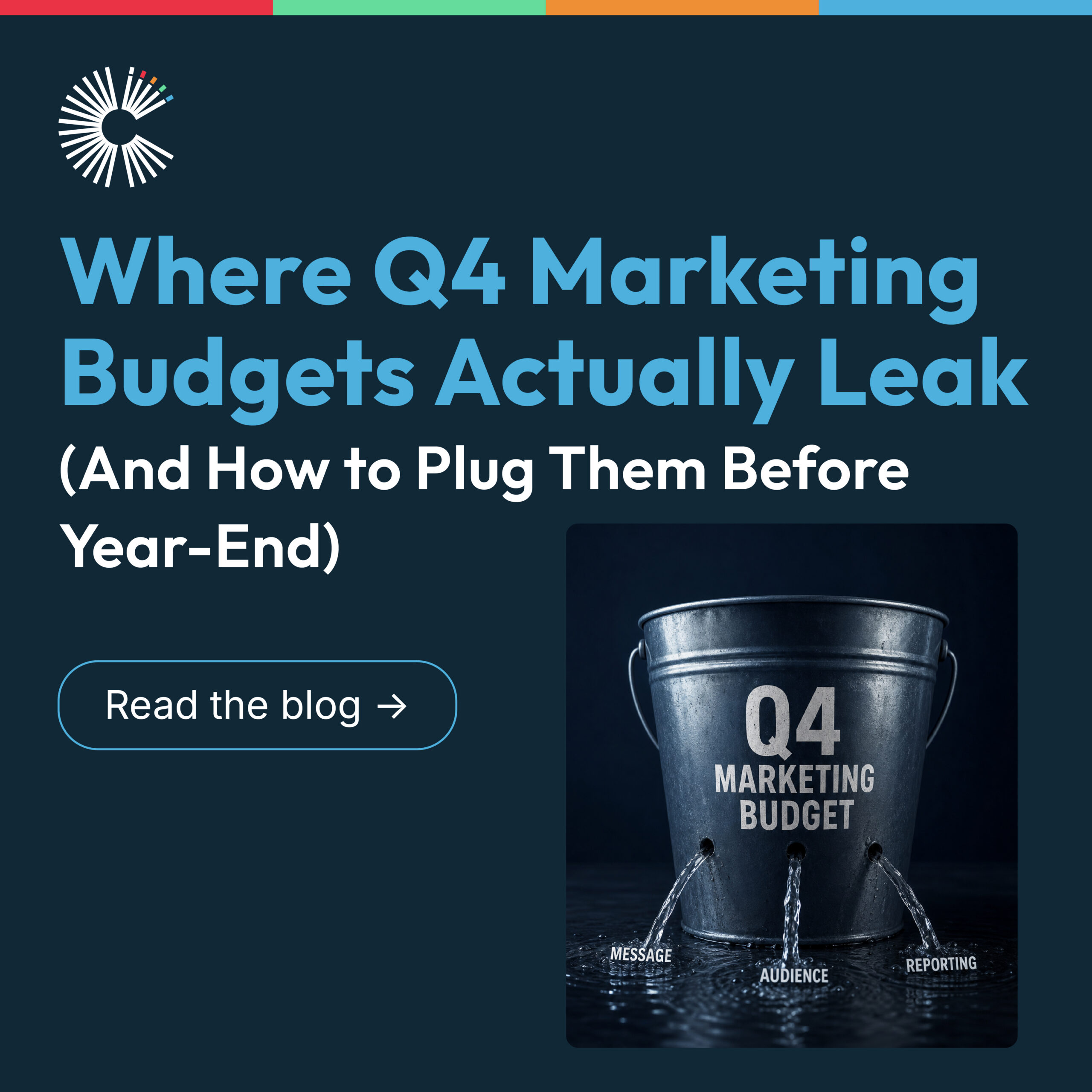
Here’s a question most marketing leaders and business owners can’t fully answer:
Where is your Q4 budget actually going?
Not in a “here’s our media plan” way. In a “what percentage of our Q4 marketing spend is doing measurable work” kind of way.
The honest answer, for most companies, is uncomfortable. A chunk of every marketing budget, sometimes 20 to 30 percent, disappears into what we call the quiet leak. Not to fraud. Not to bad intentions. Just to the ordinary entropy of a plan built in September that meets the reality of October through December.
Q4 is the highest-stakes quarter of the year. New budgets get locked in January. Performance now sets the tone for what you’ll have to work with next year. And yet it’s also the quarter when budget leaks are most likely to go unnoticed, because everyone is heads down executing, not auditing.
This post breaks down the most common places Q4 marketing budgets quietly drain, and what to do about each one before the fiscal year closes.
Leak 1: Paying for Reach on a Message Nobody Remembers
“More impressions on an unclear message just multiplies the confusion faster.”
This is the most expensive leak most companies never see, because the spend looks normal. The campaigns are running. The impressions are accruing. The dashboards show activity. But the underlying message isn’t landing.
It happens when a Q4 push gets launched before the core message has been pressure-tested. The offer exists, the creative gets produced, and the budget gets allocated. But no one has stopped to ask: Does this message actually connect with what our buyer cares about right now? Will they remember it after one exposure? Does it differentiate us from the next three options on their list?
When the answer is no, more reach doesn’t fix it. It just delivers the same confusion to a wider audience at a higher volume. You end up with strong impression counts and weak conversion rates, which gets misread as a distribution problem when it’s actually a clarity problem.
What to do:
Stop the media plan long enough to audit the message. For your primary Q4 campaign, run the message past five people outside your team. Ask them to explain it back to you in one sentence. If they can’t, or they explain it differently from each other, the problem isn’t your targeting. Fix the message first, then scale the reach.
Leak 2: Retargeting People Who Were Never a Fit
“Broad top-of-funnel spend without qualification wastes the retargeting budget behind it.”
Retargeting is one of the most efficient tools in a Q4 media plan, when the pool is right. The problem is that most retargeting audiences are built on behavior rather than fit. Someone clicked an ad, visited a landing page, or watched 30 seconds of video. That gets them added to the audience. Whether they were ever a realistic buyer is a different question, and often nobody asked it.
The downstream effect is that the budget chases the wrong people. You’re paying to stay in front of an audience that was once curious but never going to convert — because the initial awareness activity wasn’t built on qualified criteria. The top-of-funnel spend creates the leak; the retargeting spend refills it every month.
In Q4, when budgets are compressed and expectations are high, this double-spend is particularly costly. You can’t recover the top-of-funnel waste, but you can stop throwing good money behind a bad pool.
What to do:
Before Q4 retargeting campaigns go live, audit the audience. Filter for ICP signals — company size, industry, job title, behavior depth — not just pixel fires. A smaller, better-qualified retargeting audience will outperform a large, loosely built one every time. Tighten the pool, then spend.
Leak 3: Content Built for Channels, Not for Buyers
“If it exists because ‘we need something for LinkedIn’ rather than a buyer need, it’s a cost center, not an asset.”
Q4 content calendars get crowded fast. There’s pressure to post consistently, fill slots, stay visible, and hit a cadence. The result is content that’s built around platform logic. You build on what format LinkedIn favors this week, which day gets the most reach, and what everyone else in the industry is doing, rather than on what a buyer actually needs to see to move forward.
Content that exists for a channel creates activity. Content that exists for a buyer creates momentum. The difference shows up in engagement metrics that don’t convert and assets that have to be rebuilt for every campaign because nothing compounds.
This is especially costly in Q4 because the window is short. Every piece of content that doesn’t move a buyer closer to a decision is budget spent on noise. And it’s not just the production cost, it’s the opportunity cost of the team time that could have gone toward something with actual conversion potential.
What to do:
Before any Q4 content gets greenlit, map it to a buyer question or a stage in the decision process. If you can’t answer “what does this help a buyer think, feel, or do differently?” it doesn’t get made. One piece of content that answers a real buyer question is worth more than ten posts built to fill a calendar.
Leak 4: Reporting That Tracks Activity, Not Outcomes
“Dashboards full of impressions and no pipeline numbers hide the real leak instead of finding it.”
If your Q4 reporting dashboard leads with impressions, reach, and post engagement and doesn’t connect to pipeline, revenue, or conversion data, you don’t have a measurement system. You have an activity log.
Activity metrics feel like accountability. The numbers move, the charts trend upward, and the weekly report contains data. But impressions don’t pay invoices. Engagement rates don’t tell you whether marketing is generating a qualified pipeline. And when the year-end budget conversation happens in January, the only question that matters is: what did this produce?
The deeper problem is that activity-based reporting actively hides leaks. If you’re measuring clicks and shares, you won’t see that your retargeting spend is chasing the wrong audience. You won’t see that your awareness campaigns aren’t converting. The dashboard looks fine because no one built it to find the problems.
What to do:
Rebuild your Q4 reporting framework around three questions: Did marketing generate a qualified pipeline? Did those opportunities convert at a reasonable rate? What was the cost per outcome, not per impression? You don’t need perfect attribution to do this. You need a decision to measure what matters instead of what’s easy.
Leak 5: Tools and Subscriptions Nobody’s Used This Quarter
“Audit the stack, not just the campaigns.”
This one tends to live in the background, billed monthly on a credit card no one is actively reviewing. A marketing automation platform that’s technically active but barely configured. A data tool that got stood up for a project six months ago and now runs on autopilot. A content platform, a social scheduler, an analytics add-on. Each one was a reasonable purchase at the time; each one is now part of a stack that costs more than it produces.
MarTech sprawl is a slow leak. No single line item is large enough to justify a fight, so they roll forward quarter over quarter. By Q4, you may be carrying three or four tools that overlap significantly, plus vendor retainers for services your business has quietly outgrown.
The test isn’t whether you’re paying for the tool. It’s whether anyone used it in the last 90 days to make a decision or do meaningful work. If the answer is no, or if you had to check with three people to find out, that’s your answer.
What to do:
Run a 90-day usage audit on every tool in the marketing stack and every active vendor retainer before Q4 budgets close. For each one: who used it, what did they produce with it, and what would we lose if it disappeared tomorrow? If you can’t answer the last question, it’s a candidate for cut or consolidation.
Found 2 or More? Start There.
You don’t need a major overhaul to recover real money from Q4 marketing spend. Most of these leaks are fixable before year-end if you find them in time.
Here’s the short-form diagnostic:
- Can you explain your primary Q4 message in one sentence — and does your audience agree?
- Are your retargeting audiences filtered for ICP fit, or just for pixel behavior?
- Does every active content asset connect to a buyer question or decision stage?
- Does your reporting connect to pipeline and revenue — not just impressions?
- Have all the tools and retainers in your stack been actively used in the last 90 days?
If two or more of these land as “honestly, no,” those are your leaks. Start plugging them in before you plan next year’s budget, or you’ll carry the same inefficiencies into the new budget.
“Clarity first. Tactics second.” — Conan Venus and Company
At CVAC, we run marketing budget audits built to surface exactly these issues, and give you a clear, prioritized action plan before year-end close. It’s an honest look at where your Q4 marketing spend is going and where it should go instead.