
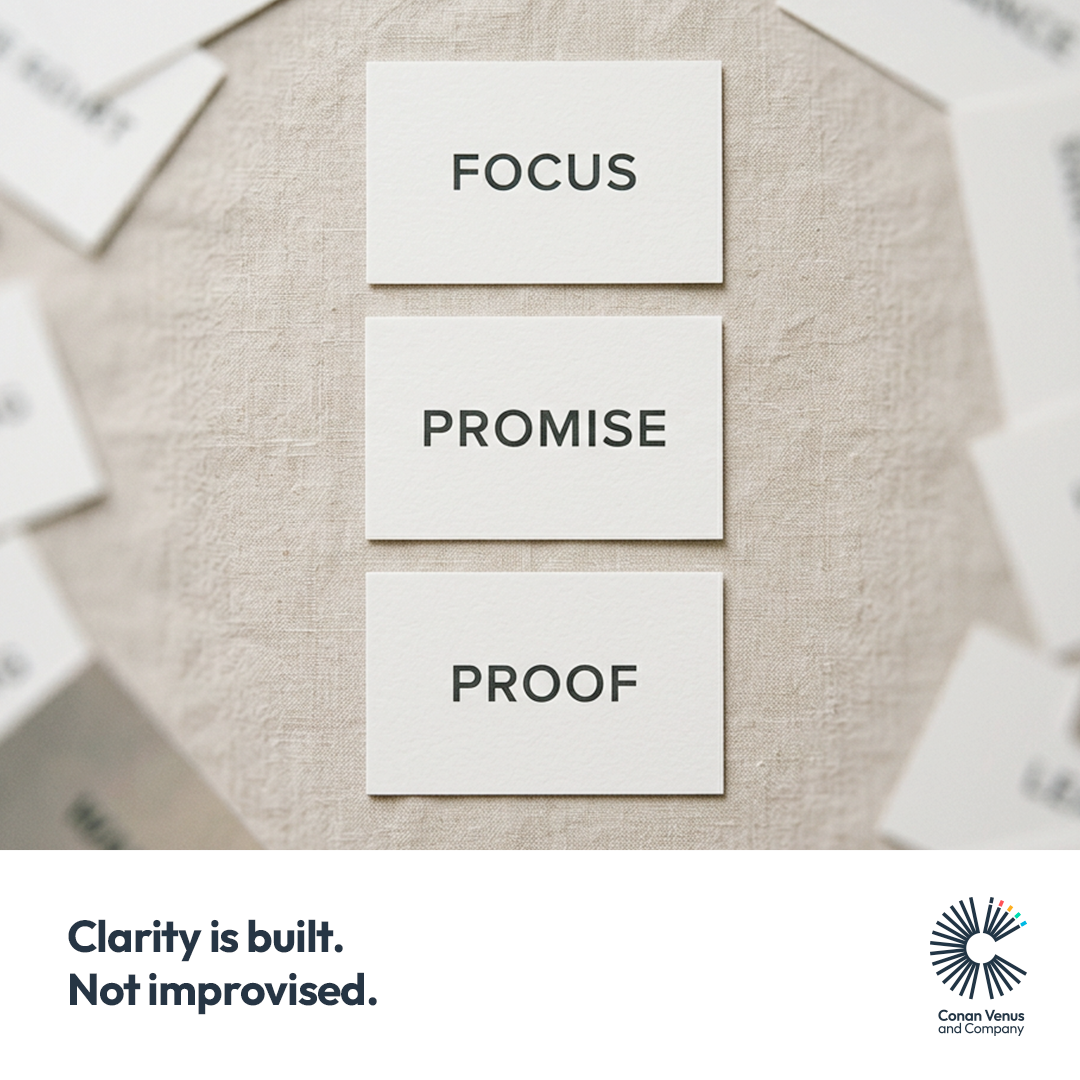
When we review brands that remain consistent across campaigns, sales conversations, packaging, and digital channels, we notice that their edge over others isn’t in creative talent. It’s in their foundation. Underneath the visible work, there is usually a simple structure holding everything together.
Across both CPG and B2B brands, we repeatedly see the same three building blocks behind strong brand messaging clarity.
Focus.
Promise.
Proof.When those three align, clarity scales. When they don’t, confusion follows.
1. Focus: Who the brand is really for
Brand messaging clarity begins with a decision about the audience.
As companies grow, audiences tend to expand. New segments get added. Edge cases become opportunities. Sales conversations widen the scope. Campaigns aim to capture more attention.
Each decision is reasonable. Over time, the brand stops speaking to someone specific and starts speaking more generally.
Without focus, messaging becomes inclusive but less distinctive. Every benefit feels important. Every claim feels necessary.
Clear brand positioning starts by defining who the brand is truly for, and letting that decision narrow everything else. Focus gives growth direction.
2. Promise: What the brand consistently delivers
Once focus is clear, the next building block of brand messaging clarity is the promise.
What does this brand reliably deliver to the audience it has chosen?
In CPG, that promise often becomes diluted by campaign cycles. Seasonal pushes, promotional angles, and rotating claims take turns leading the story.
In B2B, the promise can become buried beneath explanation. Value propositions multiply. Capability lists expand. The message adapts in every sales conversation.
When the promise shifts depending on context, recognition weakens. The brand may still perform, but it becomes harder to remember and harder to repeat.
A clear promise provides direction. It ensures that campaigns, content, and conversations reinforce the same central idea instead of competing with it.
3. Proof: Why the promise is credible
A promise without proof doesn’t sustain brand messaging clarity.
Proof is what anchors positioning in reality.
In CPG, proof might take the form of product performance, sourcing standards, repeat purchase rates, or third-party certifications. In B2B, proof often takes the form of case studies, delivery metrics, partnerships, or outcomes achieved.
When proof points operate independently rather than reinforcing the central promise, messaging becomes fragmented. Awards, sustainability claims, and metrics float separately instead of stacking beneath a clear idea.
Proof should strengthen the promise.
How the building blocks create a messaging framework
When focus, promise, and proof align, they form a simple brand messaging framework.
Focus defines who the brand serves.
Promise defines what it delivers.
Proof defines why that delivery can be trusted.
This messaging hierarchy allows brands to evolve without drifting. Campaigns can change. Channels can expand. Sales conversations can adapt. The core story remains intact.
Without this structure, brand messaging clarity depends on constant correction. Teams spend time realigning instead of reinforcing.
With it, clarity becomes durable.
When alignment needs to move faster
Sometimes the issue isn’t understanding the building blocks. It’s aligning them across the organization.
Different leaders hold different interpretations. Sales and marketing emphasize different strengths. Campaign language drifts from positioning.
When that happens, incremental fixes don’t hold.
That’s typically where a Brand and Message Sprint becomes useful.
It’s a focused engagement designed to define and align focus, promise, and proof in a structured way so they can be applied consistently across the business.
The process moves through three practical stages.
First, alignment.
Existing materials are reviewed to identify where focus drifts, where the promise shifts, and where proof competes rather than reinforces.
Second, definition.
Leadership decisions are clarified. Who is the priority audience? What is the single promise the brand stands behind? Which proof points truly support it?
Third, structuring the language.
Those decisions are translated into a usable messaging framework that can guide website copy, sales materials, packaging, and campaigns.
The outcome is alignment. The work results in language teams can actually use across sales, marketing, and leadership.
Teams leave with:
- A clearly defined priority audience
- A single, defensible brand promise
- Structured proof points
- A messaging hierarchy that holds up under pressure
Rebuilding brand messaging clarity
In some cases, a broader Marketing Audit provides the initial diagnosis.
In others, the Sprint becomes the fastest path to alignment.
Brand messaging clarity usually improves after a series of deliberate decisions. The brands that hold up over time tend to make those decisions consistently and reinforce them across the business.
The work is less dramatic than a rebrand would be. It is far more durable.
Where to begin
If the gaps feel structural rather than tactical, a Marketing Audit can clarify where alignment has drifted.
And when the priority is defining and applying focus, promise, and proof quickly, a Brand and Message Sprint provides the framework and language to move forward with confidence.
Brand messaging clarity is built deliberately.
If this feels familiar, we’re always open to a conversation. Book a free consult today.