
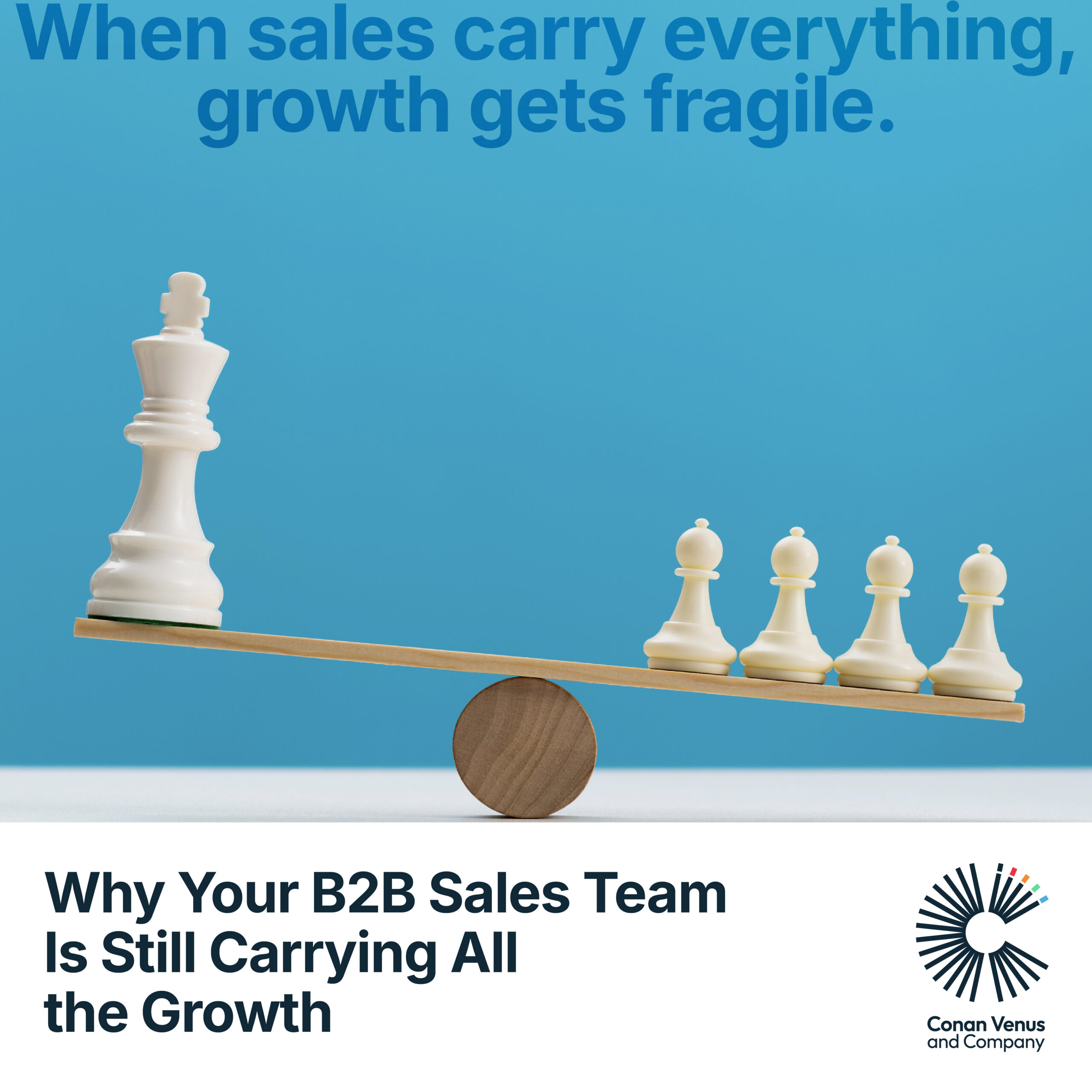
In many B2B businesses we have worked with, we often hear this:
“Sales drive the revenue. Marketing supports where it can.”
At first glance, it sounds reasonable. Sales talk to customers. Sales close deals. Sales bring in the money.
The problem is not that sales are strong. The problem is that growth becomes fragile when sales are the only engine powering the company.
We see this pattern across B2B manufacturing, industrial services, technology, and professional firms. The business looks healthy on the surface. Revenue is coming in. Long-standing customers renew. Referrals keep the pipeline alive.
But scratch a little deeper, and leadership starts to feel exposed.
If marketing were working properly, sales would not have to carry this much weight.
The Hidden Risk of Sales-Led Growth
Sales-led growth feels safe because it is familiar.
Your best salespeople know the accounts. They understand the politics. They can read a room. They know which levers to pull to get deals across the line.
But sales-led growth has limits.
It depends heavily on individuals.
It is difficult to scale.
It plateaus quietly.
A useful thought experiment we often share with leadership teams is this:
If your top three salespeople left tomorrow, what would happen to revenue over the next 12 months?
If the honest answer makes you uncomfortable, marketing is not doing enough of the heavy lifting.
Five Patterns We See When Sales Are Carrying Too Much
1. Most Deals Still Come From Referrals and Existing Customers
Referrals are valuable, and repeat business is healthy. But neither is a strategy on its own.
When the majority of the pipeline comes from relationships built years ago, growth becomes reactive. It depends on goodwill rather than systems.
Common signs include:
- Limited visibility into where new opportunities originate
- A thin top of the funnel
- Marketing reporting activity, not opportunity quality
- Leadership assumes “this is just how B2B works.”
Strong B2B marketing does not replace sales relationships. It multiplies them by creating demand beyond the existing network.
2. The Website Is a Brochure, Not a Salesperson
Many B2B websites are well designed, technically sound, and largely ineffective.
They explain what the company does, list capabilities, and showcase credentials. What they do not do is help buyers move forward.
Typical issues:
- Messaging is generic because no clear ICP is defined
- Value propositions sound similar to competitors
- Calls to action are weak or buried
- Content educates lightly but never challenges
When marketing works, the website plays a part in the sales process. It qualifies interest, sets expectations, and prepares buyers for a conversation.
When it does not, sales starts every call from scratch.
3. Trade Shows Are Treated as Events, Not Pipeline Systems
Trade shows are expensive. Booths, travel, sponsorships, collateral, and time away from selling add up quickly.
Yet in many B2B firms, trade shows are still measured by:
- Number of conversations
- Badge scans
- Gut feel
What is missing is structure.
- Little pre-event outreach
- No clear audience prioritisation
- Weak follow-up discipline
- No shared view of pipeline impact
When sales carry growth, trade shows become bursts of activity with little downstream leverage. When marketing works, events are integrated into a pipeline system with clear roles and expectations.
4. No One Can See the Pipeline Clearly
Ask leadership where growth is coming from, and you will often hear a range of answers.
Sales has one view.
Marketing has another.
CRM data is incomplete or inconsistently used.
Reports contradict each other.
This lack of clarity forces sales to carry even more weight, because leadership defaults to trusting the people closest to revenue.
Marketing becomes reactive, defending its value rather than shaping growth.
Good marketing creates transparency. Transparency creates trust. Trust creates leverage.
5. Sales and Marketing Are Not Working From the Same Playbook
This is the most damaging pattern of all.
Sales believes marketing is too abstract.
Marketing believes sales do not follow up properly.
Both are partially right.
What is missing is a shared definition of:
- Who the company is targeting
- What problems matter most
- What success looks like at each stage of the funnel
Without alignment, marketing produces noise, and sales filters it manually. Growth happens, but inefficiently and at human cost.
What These Patterns Have in Common
None of these issues is fixed by another tool, another campaign, or another agency presentation.
They are symptoms of a system that has never been properly examined end-to-end.
B2B marketing becomes powerful when it is designed as an operating system rather than a support function.
This is where a B2B marketing audit earns its keep.
What a B2B Marketing Audit Actually Reveals
A proper audit does not judge effort. It examines reality.
In our B2B marketing audits, we look across:
- Target segments and ICP clarity
- Core messaging and differentiation
- Website performance as a sales asset
- Campaign structure and intent
- Event strategy and follow-up systems
- CRM usage and reporting discipline
- Sales and marketing alignment in practice
The goal is not to overwhelm teams with insight. It is to give leadership a clean, shared view of where marketing supports growth and where it leaks.
The output includes:
- A short executive summary with clear findings
- A prioritised view of what to stop, fix, and build
- Practical next steps tied to revenue, not vanity metrics
Most importantly, it shifts marketing from “support” to “shared ownership of growth.”
Why February Matters
February is when many B2B organisations finalise budgets, set targets, and commit to plans that will shape the year.
It is also when momentum builds, and reflection disappears.
That makes February the ideal moment for a structured marketing checkup.
If you want to reduce reliance on individual sales performance and build a growth engine that scales, there are two sensible next steps.
- Book a February Marketing Checkup for a focused B2B marketing audit
- Start with our 10-minute Executive Marketing Self Assessment to establish a baseline
Neither option is about changing everything. Both are about understanding what actually deserves your energy.
Because in B2B, the strongest sales teams are backed by marketing that carries its share of the load.