
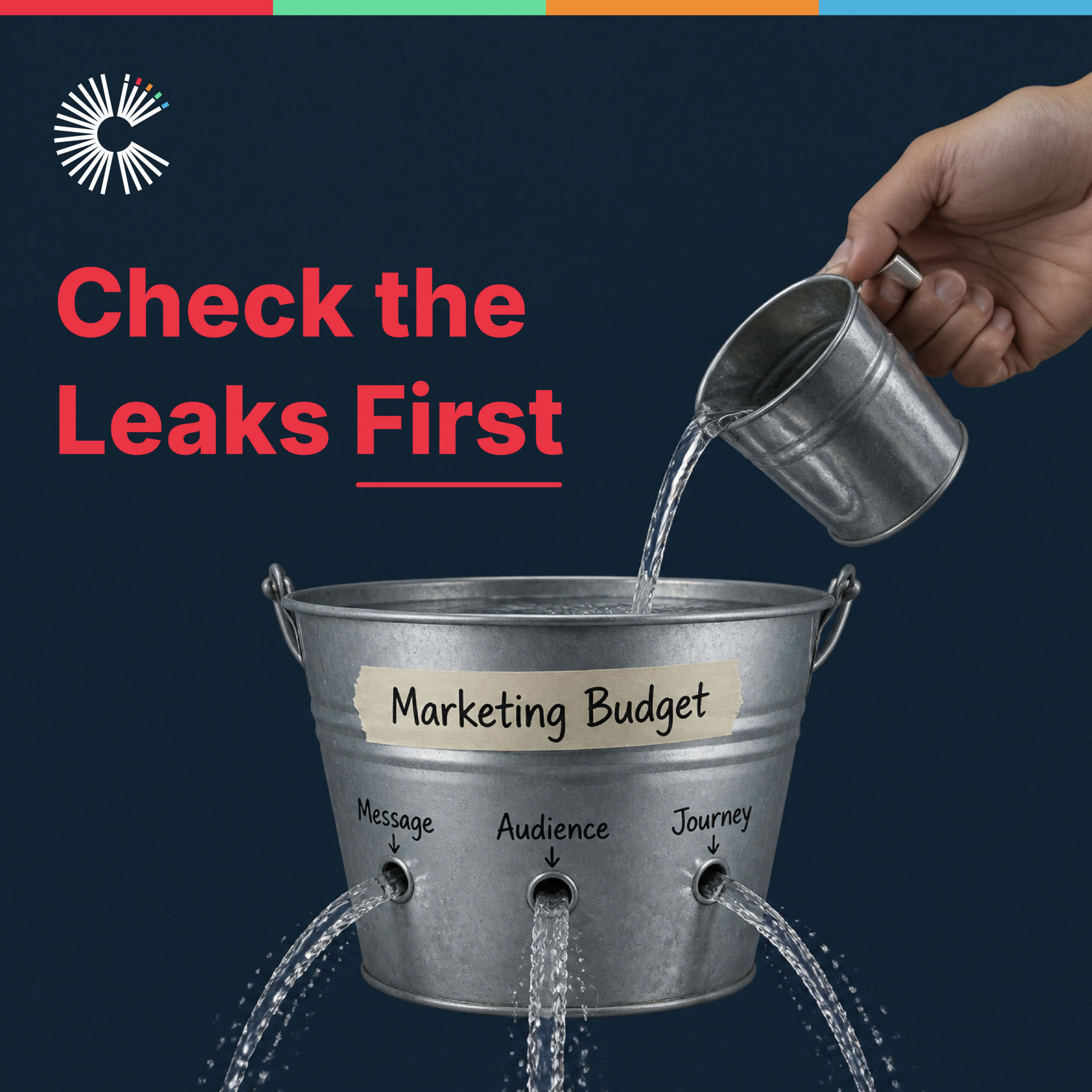
When marketing performance drops, the first instinct is usually simple:
Spend more.
- More ad budget.
- More content.
- More email.
- More social posts.
- More trade show presence.
- More campaigns.
- More everything.
Sometimes, more budget is the right move.
But sometimes, increasing your marketing budget before diagnosing the problem is like pouring more water into a leaky bucket and calling it a hydration strategy.
The problem may not be the size of the budget. The problem may be what the budget is being asked to fix.
If leads are down, sales are slower, engagement is soft, or campaigns are underperforming, it is tempting to assume you need more reach. But performance drops can come from several places. Your message may not be clear. Your audience targeting may be off. Your customer journey may have friction. Your sales materials may not support the decision. Your offer may not be landing. Your channels may not be working together.
A bigger budget can help when the strategy is sound.
It can also make a broken strategy more expensive.
Before you increase your marketing spend, check these three things first.
1. Check the Message
Start here because message problems are sneaky.
A company can have a strong product, a good reputation, an experienced team, and a real market opportunity, but if the message is unclear, the marketing still struggles.
The message is what tells your audience:
- What you do;
- Why it matters;
- Who it is for;
- Why they should care now; and
- Why should they choose you instead of another option.
When that message is too broad, too generic, too complicated, or too internally focused, performance drops.
The hard part is that unclear messaging often appears to be a media problem from the outside.
The ad is not getting clicks.
The email is not getting responses.
The website is not converting.
The brochure is not helping sales.
The social posts are not getting engagement.
So the team thinks, “We need more people to see this.”
Maybe.
But first, ask whether the thing they are seeing is clear enough to work.
More visibility will not fix a message nobody understands.
Signs Your Message May Be the Problem
Your message may need work if:
- Your homepage does not quickly explain what you do and why it matters.
- Your sales team explains the company differently depending on who is talking.
- Your campaigns lead with features but do not connect to buyer pain points.
- Your marketing sounds like every competitor’s.
- Your audience has to work too hard to understand the value.
- Your materials are full of claims but light on clarity.
This is especially important for growing companies. As businesses expand, messaging often gets messier. New products are added. New audiences are pursued. New capabilities are developed. New sales priorities come into play. Before long, the brand message turns into a group project with no editor.
That does not mean the company is weak.
It means the message needs hierarchy.
What to Ask Before Spending More
Before increasing your marketing budget, ask:
Is our value clear within a few seconds?
If someone lands on your website, sees your ad, or opens your email, will they understand the point quickly?
Are we leading with what the buyer cares about?
Many companies lead with what they are proud of. That is not always the same as what the buyer needs to hear first.
Is our message different enough to matter?
If your competitors could use the same headline, it is probably not sharp enough.
Do our proof points support the main message?
Strong messaging is not just a claim. It needs proof, examples, specifics, and relevance.
If the message is unclear, more budget may only help more people ignore it.
Fix the message first.
2. Check the Audience
The second thing to check is whether your marketing is reaching the right people.
Not just more people.
The right people.
This distinction matters because reach can be very seductive. Big numbers look good in reports. Impressions, views, traffic, followers, open rates, and clicks can all create the feeling that marketing is working.
But if the audience is wrong, those numbers are mostly decoration.
Nice to look at. Not necessarily useful.
A campaign can generate traffic and still miss the people who actually influence or make buying decisions. A social post can get engagement from people who will never buy. An email list can be large but stale. An ad campaign can reach a broad audience but miss the specific segment with the highest intent.
Before you increase your marketing budget, make sure you are not simply paying to reach more of the wrong people.
Audience Problems Often Hide Inside “Awareness”
Awareness is important. But awareness without audience clarity can get expensive fast.
For B2B, CPG, and manufacturing companies, buying decisions are rarely simple. There may be owners, presidents, CMOs, VPs of sales and marketing, innovation leaders, brand managers, procurement teams, distributors, retailers, or internal influencers involved.
Each audience may care about something different.
A CEO may care about growth and competitive position.
A VP of Sales may care about lead quality and sales support.
A marketing director may care about campaign performance and execution.
A buyer may care about margin, demand, risk, and reliability.
An operations stakeholder may care about feasibility and consistency.
If your marketing treats all of these people the same, it may not connect deeply with any of them.
That does not mean every campaign needs ten versions. It means your strategy should be clear about who matters most for the specific goal.
Signs Your Audience Targeting May Be the Problem
Audience targeting may need work if:
- Leads are coming in, but they are not the right fit.
- Sales says the lead quality is weak.
- Website traffic is up, but conversions are flat.
- Campaigns are built around broad demographics instead of buyer needs.
- Your content speaks to “everyone,” but it doesn’t feel specific to anyone.
- You are targeting the same audience across every channel without considering intent.
This is where many companies confuse activity with progress.
Posting more often does not help if the content is not built for the right decision-maker. Running more ads does not help if the targeting is too broad. Creating more content does not help if it answers questions your best buyers are not asking.
What to Ask Before Spending More
Before increasing your marketing budget, ask:
Who exactly are we trying to influence?
Be specific. “Manufacturers” is a market. “VPs of Sales and Marketing at growing mid-sized food manufacturers looking to enter new retail channels” is closer to an audience.
Are we solving a problem this audience actually cares about?
The best marketing connects to a real pressure point.
Are we matching the message to the buyer’s role?
Different stakeholders need different reasons to believe.
Are we measuring lead quality, not just lead quantity?
More leads are not better if sales cannot use them.
When the audience is wrong, the budget works harder than it should.
Tighten the target first.
3. Check the Journey
The third thing to check is the customer journey.
This is where the leak often shows up.
Your marketing may be reaching the right people. The message may be decent. The campaign may even be getting attention. But if the next step is confusing, weak, slow, disconnected, or poorly supported, performance can still drop.
The journey is what happens between first attention and final decision.
It includes the website experience, landing pages, contact forms, follow-up emails, sales materials, nurture content, calls-to-action, proposals, retargeting, reporting, and every handoff along the way.
In other words, it is where good campaigns either turn into business opportunities or quietly disappear into the fog.
A Budget Increase Cannot Fix a Broken Path
Imagine running a strong ad campaign that sends people to a landing page with too much copy, no clear offer, and a form that feels like a mortgage application.
Or publishing helpful content with no next step.
Or generating leads that sit too long before follow-up.
Or sending prospects to a website that does not reflect the same message they saw in the campaign.
Or asking people to “Contact Us” when they are not ready to contact anyone yet.
These are journey problems.
And journey problems are expensive because they waste the attention you already paid for.
Signs Your Journey May Be the Problem
Your customer journey may need work if:
- Traffic is coming in, but conversion rates are low.
- People engage with content but do not take the next step.
- Leads are generated, but not consistently followed up on.
- Sales materials do not match the campaign message.
- Prospects ask the same basic questions late in the process.
- Your calls-to-action are vague or too aggressive for the buyer’s stage.
- Reporting shows activity, but not clear movement through the funnel.
This is why marketing cannot be judged only by the top of the funnel.
A full pipeline needs more than attention. It needs progression.
What to Ask Before Spending More
Before increasing your marketing budget, ask:
Where are people dropping off?
Look at the journey stage by stage. Awareness, engagement, conversion, follow-up, sales conversation, decision.
Is the next step clear?
Every piece of marketing should help the buyer know what to do next.
Do we have the right content for each stage?
Early-stage buyers may need education. Later-stage buyers may need proof, comparison, specifications, or sales support.
Are marketing and sales aligned?
If marketing creates interest but sales lacks the tools or processes to continue the conversation, opportunities get lost.
Are we measuring the right things?
Clicks and impressions matter, but they do not tell the whole story. Look for movement, quality, and conversion.
If the journey is broken, more budget puts more people into the same broken experience.
Fix the path first.
When Should You Increase the Marketing Budget?
This is not an argument against increasing your marketing budget.
Growth often requires investment. If your strategy is clear, your audience is well-defined, your message is strong, and your journey is working, then more budget can help you scale.
The key is sequence.
Diagnose first.
Spend second.
A stronger budget can help you:
- Reach more of the right audience.
- Test new channels.
- Build better content.
- Support sales more effectively.
- Improve campaign frequency.
- Expand into new markets.
- Accelerate what is already working.
But without a diagnosis, more spending can hide the real issue.
It can make reports look busier while the business result stays flat.
That is not growth. That is motion.
And motion is not the same as progress.
The Better Question
When performance drops, the question should not be:
“How much more should we spend?”
The better question is:
“What is preventing our current marketing from working harder?”
That question leads to better decisions.
Maybe the message needs to be clarified.
Maybe the audience needs to be narrowed.
Maybe the website needs to convert better.
Maybe the sales team needs stronger materials.
Maybe the campaign needs a better offer.
Maybe the channel mix needs to change.
Maybe the reporting is measuring activity instead of business impact.
Once you know the real issue, the budget conversation becomes much more useful.
Because now you are not just spending more.
You are investing smarter.
Before you increase your marketing budget, make sure you know what is actually holding performance back.
CVAC helps growing companies diagnose the gaps through marketing audits, strategy, messaging, audience clarity, channel planning, and optimization. We help you find the leak before you fund it.
Need a clearer view of what is working, what is not, and what to do next?