
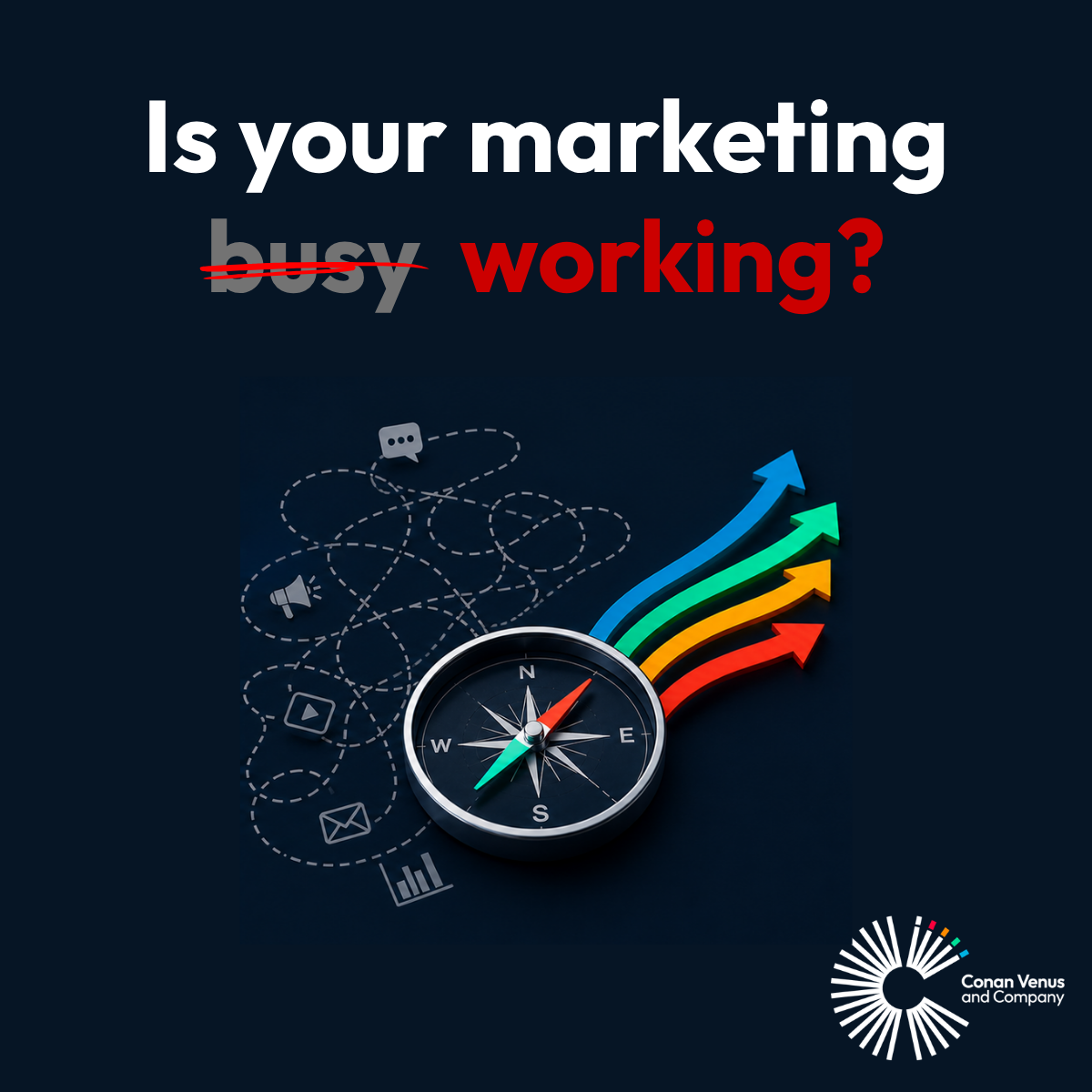
Most marketing doesn’t fail in obvious ways. It doesn’t trigger alarms. It just… keeps going.
Campaigns get approved, content goes out, and reports get shared.
And yet, when you step back and look at the business, not much has changed.
That’s the uncomfortable part.
Marketing can look productive while being completely ineffective.
We’ve worked with companies running full-scale campaigns across multiple channels, and are still unable to answer one simple question:
“What is this actually doing for the business?”
If that question feels harder than it should, this article will help you fix that.
The Problem: There’s Activity, But There’s No Progress
Most marketing teams are set up to stay busy.
There’s always something to launch, post, or report. That creates a rhythm that feels like progress. But activity and progress are not the same thing.
You can run:
- a dozen campaigns in a quarter
- across multiple channels
- with regular reporting
…and still not move the business forward.
You start to notice it in small ways.
- Customer acquisition cost isn’t improving
- Sales cycles aren’t shortening
- Conversion rates are flat
Then nothing meaningful is changing.
You don’t have a marketing engine. You have a content treadmill.
Treadmills are great for effort, but are terrible for direction.
The 3 Signals Your Marketing Is Actually Working
When marketing is doing its job properly, it leaves signals.
1. You can trace it back to commercial impact
You should be able to explain, in plain terms, how your marketing is helping the business.
- Which campaigns are bringing in better leads?
- Which channels are bringing revenue?
- Which messages make sales conversations easier?
If that link feels vague, there’s usually a gap somewhere upstream. Either in the strategy, the targeting, or the way success is being measured.
2. Performance becomes predictable
Strong marketing doesn’t rely on “wins”; it builds patterns.
You should start seeing things like:
- Certain messages consistently outperform others
- Specific channels drive better-quality leads
- Conversion rates stabilize (then improve)
Predictability is what allows you to scale. Without it, every campaign is a gamble, and gambling is not a growth strategy.
3. Your decision-making gets faster (and sharper)
When marketing is working, decision-making speeds up. Over time, your team should:
- Spend less time debating direction
- Make faster calls on what to double down on
- Kill underperforming ideas earlier
Because you’ve seen enough to know what tends to work.
If every decision still feels heavy or unclear, it usually means the marketing isn’t producing useful insight yet.
The Hidden Trap: Vanity Metrics
Metrics aren’t the problem; what you choose to focus on is. Let’s break it down:
| Metric | What it tells you | What it doesn’t |
| Impressions | You were seen | By the right people? |
| Engagement | You were noticed | Did they care enough to act? |
| Clicks | You sparked interest | Did it convert? |
Vanity metrics are early signals. Business metrics are final outcomes.
The teams that get this right don’t ignore early metrics. They just don’t stop there. They look at what happens next.
Why Marketing Feels Like Guesswork
When results are inconsistent, most teams assume they need better execution. Better creatives, copy, or channels. Sometimes, that’s true. But more often, the issue sits higher up.
A few common ones:
- The positioning isn’t clear enough, so the message keeps shifting
- Success isn’t properly defined, so everything looks “fine”
- Marketing and sales aren’t aligned, so insight gets lost
That’s when things start to feel reactive. You try more, add more, or adjust constantly. But nothing quite sticks.
Check Where You Stand
You don’t need a full audit to sense if something’s off. Start with this.
Ask your team:
- What’s working right now
- Why it’s working
- What we’re doing next because of it
Listen to how the answers sound.
If they’re clear and grounded, you’re in a good place.
If they’re vague, cautious, or full of assumptions, there’s probably a gap in how performance is being understood.
And that gap tends to show up in results later.
Final Thoughts
Marketing shouldn’t be this hard to read. You should be able to look at what you’re doing and understand what it’s producing, where it’s helping, and where it isn’t.
That’s where most teams need support.
Not more campaigns, but a clearer view of what’s already happening.
At CVAC, that’s usually where we begin.
We look at what’s in motion, strip out what isn’t contributing, and rebuild around what actually moves the business.
If your marketing feels active but unclear, it’s worth taking a closer look.
Or reach out for a strategy session.
Because once you can see what’s working, the next steps stop feeling like guesswork.