
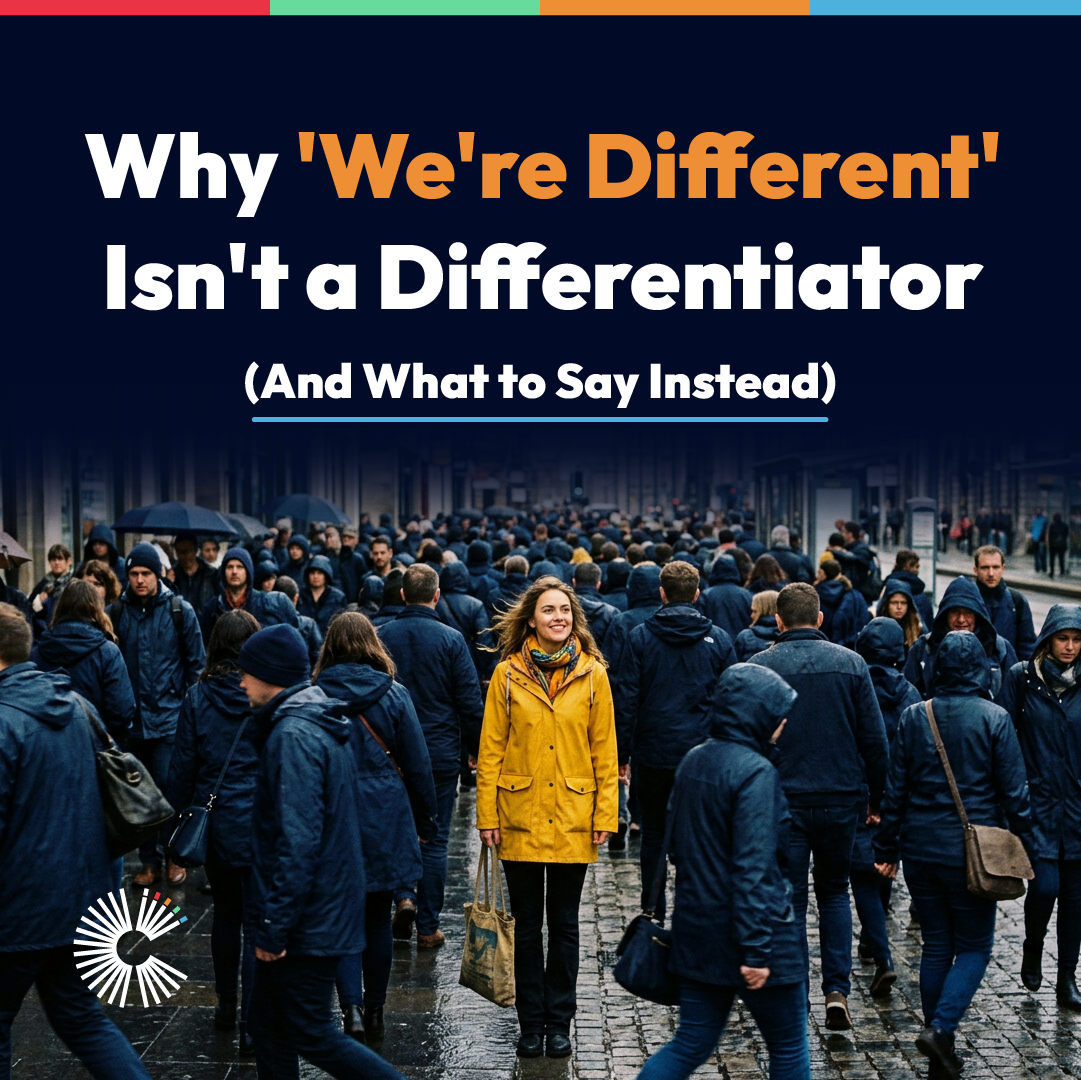
Why “We’re Different” Isn’t a Differentiator (And What to Say Instead)
Every company thinks they’re different. Almost none of them can explain how.
It’s a practical problem. Ask most companies what sets them apart, and you’ll hear some version of the same answer:
- “We’re really focused on relationships.”
- “We offer great customer service.”
- “We care more than our competitors.”
- “We bring a unique approach.”
These answers feel true. They’re usually genuine. And they’re almost entirely useless as differentiators.
Because your competitors are saying the same thing. On the same website. In the same font.
This is the differentiation trap: believing that being different and communicating a differentiator are the same activity. They are not.
Why Most Differentiation Fails
Differentiation fails for a few predictable reasons.
First, companies confuse internal truth with external relevance. A company might genuinely offer better service, more experienced people, or stronger processes. But if that truth isn’t connected to a specific buyer problem, in language buyers actually use, it doesn’t land.
Second, differentiators get softened until they disappear. Leadership reviews a bold claim and says, “We can’t say that, our competitor might say the same thing.”
So the message gets rounded down, then rounded down again, until what’s left is a collection of words that offend no one and stick with no one.
Third, companies try to differentiate on everything. “We’re faster, smarter, more experienced, more affordable, and we care more.” When everything is a differentiator, nothing is. Buyers don’t know what to hold onto, so they hold onto nothing.
The result is positioning that is technically present but functionally invisible. It exists in the brand guide. It doesn’t exist in the buyer’s mind.
What a Real Differentiator Actually Looks Like
A real differentiator does three things: it is true, it is relevant to the buyer, and it is something your competitors can’t easily claim.
Notice what’s not on that list: “impressive,” “comprehensive,” or “innovative.” Those are table stakes for entering a category, not reasons for choosing you specifically.
A real differentiator might look like:
- Specific expertise in a narrow industry segment: “We build brands for food manufacturers entering national retail, not general CPG companies trying to figure it out.”
- A proprietary process with visible proof: “Our STANDOUT process has helped 30+ mid-sized brands increase qualified leads within 90 days of engagement.”
- A clear point of view that attracts the right clients and actively repels the wrong ones: “We don’t do retainer-for-retainer’s-sake work. We come in, build the strategic foundation, and teach your team to run it.”
These are defensible. They’re specific. They create resonance with the right buyer and clear self-selection for the wrong ones. That’s not an accident, that’s the point.
The Self-Selection Test
Here’s a useful test for any differentiator: does it repel anyone?
If your positioning is so broad and inoffensive that literally every possible buyer could be your ideal client, it isn’t positioning — it’s a waiting room.
Good positioning attracts the right buyer sharply and makes the wrong buyer self-select out. That’s not a bad outcome. That’s efficiency. When the right buyer encounters specific, relevant positioning, they feel spoken to directly. They don’t have to work to figure out whether you’re the right fit — it’s obvious.
“We work with mid-sized B2B manufacturers who are ready to stop looking like a startup and start competing like a national brand” is more useful than “We help companies grow.”
Both might be true. Only one does any work.
The Competitor Test
Before finalizing any positioning claim, run the competitor test: can your primary competitor use the same headline on their website without it being false?
If the answer is yes, the claim isn’t differentiation. It’s category language. It says “we are a legitimate option in this space,” which is necessary but not sufficient.
Differentiation requires specificity that competitors can’t honestly copy. That might be:
- The specific type of client you serve and the specific problem you solve for them
- The specific outcome you consistently deliver and the process that produces it
- A point of view about how the work should be done that reflects real choices and trade-offs
These things take honesty to articulate. They require knowing what you’re good at, who you’re best for, and what you’re actually willing to stand behind — which is harder than it sounds.
How to Find Your Real Differentiator
The best starting point for finding your real differentiator isn’t a positioning workshop. It’s your best clients.
Look at the companies or customers where the results were strong, and the relationship was good. What do they have in common? What problem were they really trying to solve when they came to you? What was the alternative they almost chose instead — and why didn’t they?
The gap between what your best clients were looking for and what the alternatives offered them is often where your real differentiator lives.
Then ask your sales team: what question do you keep hearing from buyers that nobody else seems to answer well? What objection comes up every time? What do buyers say when they explain why they chose you — not what they said in the proposal process, but what they said afterward?
And ask your existing clients directly: why did you actually choose us?
Not what you hoped they’d say. What they actually say, in their language, unprompted. That language is often more useful than anything an internal team generates in a conference room.
Don’t Confuse Personality With Positioning
Brand voice, culture, and personality matter. Being smart, direct, and genuinely invested in client outcomes is a real competitive advantage in agencies and professional services.
But personality is not positioning. It’s how the positioning is delivered, not what the positioning says.
“Smart, fun, experienced” is a tone. The differentiator is what you do, for whom, and why it matters in a way your competitors can’t easily own.
Both have to work together. A strong personality without clear positioning creates a memorable brand that no one knows how to hire. Clear positioning without personality creates a credible brand that no one enjoys working with. You need both.
The Tighter the Claim, the Stronger the Brand
The instinct is almost always to go broad. More audiences, more problems, more services, more use cases — more potential customers. The logic seems sound: cast a wider net, catch more fish.
But broad positioning usually results in fewer actual customers, because no one feels spoken to directly. A message for everyone lands with no one.
The tighter the claim, the more it resonates with the buyer it’s built for. And the more it resonates, the less convincing you have to do — because the right buyer feels like you already understand their problem before the conversation starts.
That is not a small thing. It’s the difference between a sales process that feels like a discovery and a sales process that feels like a pitch. Buyers can tell the difference. And they trust the former far more than the latter.
What to Do If Your Differentiation Is Weak Right Now
If you read through this and recognized your own positioning — broad, inoffensive, interchangeable with your competitors — the answer isn’t a quick fix. Repositioning takes real work.
But the starting point is simple: get honest about what you’re actually best at, for whom, and why that matters in terms your best buyers actually use.
Then test it.
Does it pass the competitor test? Does it repel anyone? Does it give a specific buyer a specific reason to believe you’re the right choice?
If not, keep sharpening. The right positioning usually feels a little uncomfortable because it requires specificity that creates real risk — the risk that some potential clients will disqualify themselves. That discomfort is usually a sign you’re getting somewhere useful.
If you can replace your company’s name with a competitor’s name and the positioning still works, it isn’t differentiation. It’s just a decoration.
Real differentiation takes honesty, specificity, and the willingness to be less interesting to more people so you can be exactly right for the right ones.
CVAC helps growing companies in B2B, CPG, and manufacturing find, articulate, and activate what actually makes them worth choosing.
Ready to find yours? Start with a CVAC brand and positioning audit.