
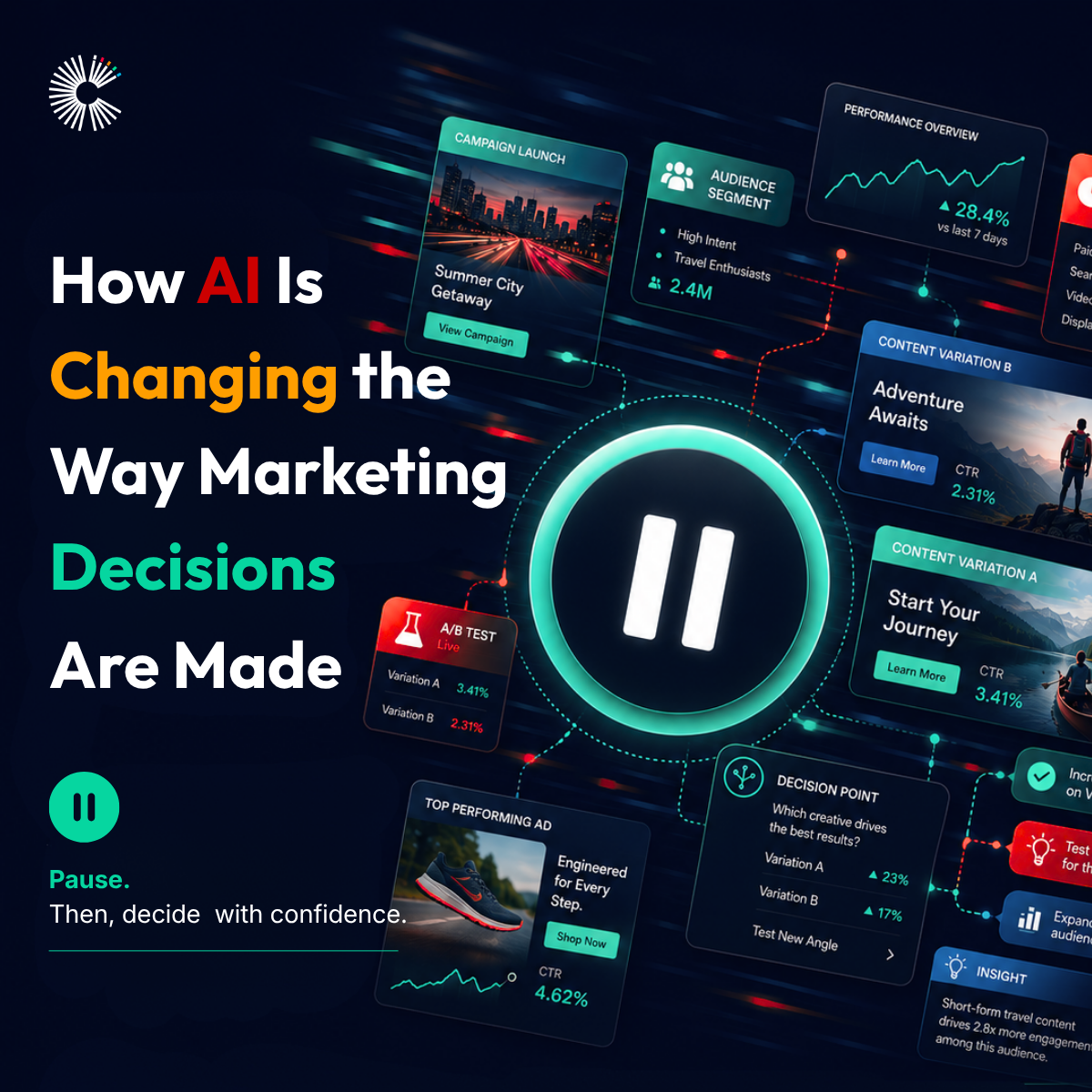
AI has changed how marketing decisions are made before anything goes live.
The shift is easy to miss. Because on the surface, everything looks like progress: faster output, more ideas, more campaigns moving at once.
But underneath that, something more fundamental is happening.
The way teams choose what to do is changing.
For marketing teams, the challenge is no longer simply producing more content. It is knowing which ideas deserve to be produced in the first place.
And if you don’t adjust how those decisions are made, AI won’t help you improve your marketing. Let us warn you, it may help you scale the WRONG things, faster.
The Real Shift: From Scarcity to Abundance
Before AI, execution had constraints. You couldn’t produce everything, so you had to choose carefully. That forced a certain level of discipline.
Now, that constraint is gone. You can generate ten campaign directions in the time it used to take to write one.
Which means the problem has flipped.
It’s no longer:
What can we produce?
It’s:
What is actually worth producing?
That shift changes AI in marketing decision-making in three important ways.
1. AI Is Making Marketing Decisions Happen Faster Than Strategic Thinking
AI removes the time between idea and execution. You can go from concept to output almost immediately.
That sounds efficient, but it also means decisions are being made with less friction and often less scrutiny.
Instead of pressure-testing an idea, teams move straight into producing variations of it.
So the question shifts from:
“Is this the right direction?”
To:
“Which version of this should we run?”
That’s a lower-quality decision.
In many teams, this shows up in a very specific way.
Someone generates a set of campaign ideas using AI. Within minutes, there are headlines, angles, and even full drafts ready to go.
The conversation moves quickly.
“What do we think?”
“Which one feels strongest?”
“Let’s test a few.”
And before anyone has really stepped back, something is already in production.
There’s no moment where someone asks:
“Is this direction actually worth pursuing?”
That question used to come naturally, because creating anything took time. Now it has to be asked deliberately.
Without it, teams end up refining ideas that were never particularly strong to begin with. A shinier paper airplane still doesn’t make it a strategy.
What to Do Instead:
Reintroduce a pause.
Before using AI, get clear on:
- What you’re trying to say
- Who it’s for
- What outcome you want
Use AI after that point, not as a shortcut to get there.
AI can help you move faster. But the strategy still needs to steer the car.
2. More AI-Generated Options Can Lead to Weaker Choices
AI gives you endless variations: headlines, angles, formats, hooks.
It feels like an advantage, but in practice, it often leads to comparison rather than clarity.
Teams get stuck choosing between options that are all… roughly similar.
The decision becomes subjective:
“This one sounds better.”
“This feels stronger.”
Instead of strategic:
“This aligns with what we know works.”
That is where AI marketing strategy can quietly go sideways. More options can feel like better thinking, but sometimes it just creates a bigger menu of average choices.
And when every option is plausible, nothing is obvious.
What to Do Instead
Reduce before you refine.
Don’t explore ten directions just because you can.
Pick one direction you believe in, based on real insight. Then use AI to strengthen it.
That means starting with what you know:
- What your audience cares about
- What problem you are solving
- What message has strategic value
- What action you want people to take
AI is excellent at expanding a good idea. It is less reliable at deciding which idea should matter most.
That part still belongs to the team.
3. More Marketing Output Does Not Always Mean More Signal
AI makes it easy to produce more content, more campaigns, and more tests.
But unless you’re clear on what you’re measuring, more output creates more noise.
And noise makes decision-making harder.
You end up with:
- More data
- Less clarity
- Slower decisions
Because it’s no longer obvious what’s actually working.
There’s also a second-order effect here.
As output increases, reporting gets more complex. More campaigns mean more data points. More variations mean more results to interpret.
On paper, you have more information than ever. In practice, it becomes harder to see patterns.
You’re comparing too many things at once, often without a clear baseline.
So decisions slow down not because there’s a lack of data, but because there’s too much of it without a clear filter.
It’s like opening 47 browser tabs to “get organized.” Technically, there’s more information. Emotionally, everyone needs a snack.
What to Do Instead
Tighten your definition of success.
Before scaling output, be clear on:
- What counts as a meaningful result
- What signals you trust
- What you’re willing to ignore
Then produce against that.
A focused marketing decision-making process helps AI become a multiplier instead of a distraction. It gives your team a filter, not just a faster factory.
What AI Means for Marketing Strategy Going Forward
AI hasn’t removed the need for good judgment. It has made it more important.
Because when execution becomes easy, the advantage shifts to the teams that make good decisions.
AI will keep getting faster. That part is guaranteed.
The question is whether your decision-making keeps up.
For marketing leaders, the opportunity is not just to do more with AI. It is to make better choices before the work begins.
That means slowing down in the right places:
- Before choosing a campaign direction
- Before producing endless variations
- Before measuring everything and learning nothing
- Before mistaking speed for progress
At CVAC, this is where we focus.
We help teams get clear on direction before anything gets built, so AI becomes a multiplier, not a distraction.
If your marketing feels faster but less certain, it may be time to look at the decisions behind the work.
Sit down with CVAC and let’s pressure-test the thinking before AI starts multiplying it.